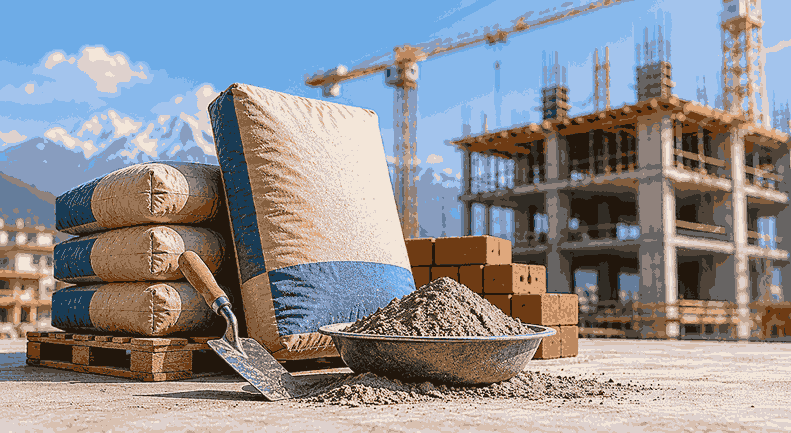
Are you considering building a structure in Nepal? In order to plan and keep control of your expenses, it is very important to know the latest cement price in Nepal. Cement is one of the most important construction materials in Nepal. So, cement price in Nepal directly impacts the total cost of your project.
The cement industry in Nepal is very dynamic because of many issues such as high transport costs, high cost of fuel, taxes levied on imported products, and seasonality in demand. Different cement brands in Nepal vary in terms of quality and price; therefore, this comparison is important.
Selecting the appropriate cement, irrespective of its cost factor, may turn out to be one of the best ways to economise on expenditure and enhance the construction quality. The most important thing for anyone involved in the construction process is to stay updated about the current cement rate in Nepal and overall building material prices.
This guide informs you about the present-day cement price in Nepal 2026, cement prices depending upon the brand names, and factors affecting the Nepal cement market. This will help you in making better plans for construction work and choosing the right cement for house construction in Nepal.
Current Cement Price in Nepal (2026 Update)
The price level of the market of cement in Nepal at the start of the year 2026 lies between NPR 500 to NPR 1,200 for 50 kg sacks of cement.
Following is an example of the current price level of the market:
Premium Cement Brands in Nepal
NPR 1,050 – NPR 1,200 per bag
- High-quality cement with excellent performance
- Can be used for the construction of high-rise buildings and constructions
- Gives better technical support
Mid-Range Cement Brands in Nepal
NPR 950 – NPR 1,050 per bag
- Offers value for money, both in terms of quality and price
- Ideal for both domestic and commercial constructions
- An easily accessible material in Nepal’s prominent markets
Budget Cement Options in Nepal
NPR 500 – NPR 950 per bag
- Good for general construction works, and not structural construction works
- Used mainly for plastering and flooring purposes
- Can be a bit longer in drying time than other cements
Remember that cement prices fluctuate in Nepal according to market conditions and logistics. Inquire about the current price from different suppliers before making your purchase.
Budget Cement Options in Nepal
NPR 500 – NPR 950 per bag
- Ideal for non-load-bearing and general construction purposes
- Typically used for plastering and flooring
- Can take somewhat longer to procure
Remember that prices vary according to market conditions and logistics. Inquire about the current price from different suppliers before making your purchase.
Cement Price List in Nepal (2026 Update)
| S.No | Brand | Grade | Price per 50kg Bag (NPR) | Price per Ton (NPR) |
| 1 | Jagdamba Cement | OPC | 780 – 830 | 15,600 – 16,600 |
| 2 | Jagdamba Cement | PPC | 610 – 750 | 12,200 – 15,000 |
| 3 | Hetauda Cement | OPC | 800 – 900 | 16,000 – 18,000 |
| 4 | Hetauda Cement | PPC | 750 – 850 | 15,000 – 17,000 |
| 5 | Arghakhanchi Cement | OPC | 750 – 800 | 15,000 – 16,000 |
| 6 | Arghakhanchi Cement | PPC | 640 – 750 | 12,800 – 15,000 |
| 7 | Ghorahi Cement | OPC | 650 – 700 | 13,000 – 14,000 |
| 8 | Ghorahi Cement | PPC | 580 | 11,600 |
| 9 | Shivam Cement | OPC | 630 – 810 | 12,600 – 16,200 |
| 10 | Shivam Cement | PPC | 520 – 730 | 10,400 – 14,600 |
| 11 | United Cement | OPC | 700 – 850 | 14,000 – 17,000 |
| 12 | United Cement | PPC | 700 – 790 | 14,000 – 15,800 |
| 13 | Maruti Cement | OPC | 750 – 850 | 15,000 – 17,000 |
| 14 | Sarbottam Cement | OPC | 720 – 850 | 14,400 – 17,000 |
| 15 | Sarbottam Cement | PPC | 590 – 750 | 11,800 – 15,000 |
| 16 | Brij Cement | OPC | 750 – 850 | 15,000 – 17,000 |
| 17 | Brij Cement | PPC | 640 – 850 | 12,800 – 17,000 |
| 18 | Shree Cement | OPC | 700 – 810 | 14,000 – 16,200 |
| 19 | Shree Cement | PPC | 650 – 750 | 13,000 – 15,000 |
| 20 | Saurya Cement | OPC | 800 – 950 | 16,000 – 19,000 |
| 21 | Reliance Cement | OPC | 750 – 850 | 15,000 – 17,000 |
| 22 | Reliance Cement | PPC | 630 – 750 | 12,600 – 15,000 |
| 23 | Hongshi-Shivam Cement | OPC | 630 – 810 | 12,600 – 16,200 |
| 24 | Hongshi-Shivam Cement | PPC | 520 – 730 | 10,400 – 14,600 |
| 25 | Premier Cement | OPC | 730 – 950 | 14,600 – 19,000 |
| 26 | Udaypur Cement | OPC | 730 – 830 | 14,600 – 16,600 |
| 27 | Siddhartha Cement | OPC | 730 – 850 | 14,600 – 17,000 |
| 28 | Siddhartha Cement | PPC | 590 – 750 | 11,800 – 15,000 |
| 29 | CG Cement | OPC | 650 – 850 | 13,000 – 17,000 |
| 30 | CG Cement | PPC | 650 – 750 | 13,000 – 15,000 |
| 31 | Ambe Cement | OPC | 800 – 950 | 16,000 – 19,000 |
| 32 | Ambe Cement | PPC | 680 – 790 | 13,600 – 15,800 |
| 33 | Bishal Cement | OPC | 730 – 910 | 14,600 – 18,200 |
| 34 | Balaji Cement | OPC | 630 – 810 | 12,600 – 16,200 |
| 35 | Palpa Cement | OPC | 590 – 850 | 11,800 – 17,000 |
| 36 | Goenka Cement | OPC | 730 – 830 | 14,600 – 16,600 |
| 37 | Agni Cement | OPC | 700 – 830 | 14,000 – 16,600 |
| 38 | Agni Cement | PPC | 600 – 800 | 12,000 – 16,000 |
| 39 | Butwal Cement | OPC | 700 – 900 | 14,000 – 18,000 |
| 40 | Lumbini Cement | OPC | 630 – 810 | 12,600 – 16,200 |
| 41 | Hongshi/Huaxin Cement | OPC | 700 – 896 | 14,000 – 17,920 |
| 42 | Hongshi/Huaxin Cement | PPC | 630 – 710 | 12,600 – 14,200 |
| 43 | Riddhi Siddhi Cement | OPC | 831 | 16,620 |
| 44 | Buddha Cement | OPC | 720 | 14,400 |
| 45 | Buddha Cement | PPC | 720 | 14,400 |
Popular Cement Brands in Nepal
The cement market in Nepal offers a wide range of brands with different quality levels, pricing, and performance. Below are some of the most popular and trusted cement brands in Nepal:
1. Shivam Cement
Among the top local brands, Shivam Cement stands out for its quality and affordability. The brand is extensively utilised in both residential and construction projects carried out by contractors.
2. Hongshi Cement
Hongshi Cement is one of the most formidable competitors in Nepal, providing a fine combination of quality and reasonable price, which makes it ideal for medium-scale construction projects.
3. Sarbottam Cement
In Nepali, the term Sarbottam means “best,” and thus Sarbottam Cement is regarded as one of the best cement brands with its excellent strength and durability.
4. Maruti Cement
Maruti Cement is well-known due to its lower cost. This brand is the best option for low-budget constructions without sacrificing quality.
5. Udayapur Cement
Udayapur Cement is one of the oldest and most reliable cement brands available in Nepal. However, the cost of this brand is relatively high compared to other brands.
6. Reliance Cement
The Reliance brand cement has better structural characteristics with a moderate price range, thus being appropriate for both domestic and commercial applications.
Types of Cement in Nepal
1. Ordinary Portland Cement (OPC)
OPC is a highly strong and rapid-setting cement utilised in massive constructions. It is best suited for skyscrapers, bridges, highways, beams, and columns. It gives immediate strength, hence perfect for work needing rapid execution, although it creates heat and is slightly expensive.
2. Portland Pozzolana Cement (PPC)
The most commonly used type of cement in Nepal is PPC. This is because it is produced using fly ash that enhances durability and resistance to cracking. It is commonly used for the construction of houses, plastering, bricklaying, and all types of construction jobs. It takes a long time to set, but it provides good strength and is economical.
3. Sulfate-Resistant Cement (SRC)
SRC is designed to prevent corrosion from sulfates in soil and water. This type of cement is utilised for the construction of marine structures, sewage works, piers, and foundation works where there is an abundance of sulfates. This cement enhances durability but is not widely available in Nepal.
4. Rapid Hardening Cement (RHC)
RHC gains strength very fast in comparison to OPC. It is used in the case of roadwork, bridge repair work, prestressed concrete, and rapid constructions. Even though it helps increase the pace of construction, RHC is mostly used in such constructions that need to be done quickly.
5. Portland Slag Cement (PSC)
PSC is manufactured using a combination of slag and OPC clinker. PSC is both durable and eco-friendly. Uses of PSC include industrial construction, marine construction, and infrastructure works.
6. White Cement
White cement is generally used for aesthetic purposes. The application areas include floorings, walling, tiles, and building construction. It provides a fine white look but is very expensive and cannot be employed in structural works.
What Affects Cement Prices in Nepal?
Several elements contribute to determining the cement price in Nepal. The following are some of the factors to consider when thinking about building your dream home in Nepal.
1. Location and Transportation
Location is an important consideration when it comes to cement prices. The cost tends to be low at locations closer to cement factories, whereas it is high in remote areas because of transport charges. For instance, cement prices in Kathmandu are much lower compared to the prices in remote regions, where shipping charges add to the total price.
2. Type of Cement
Cement is also available at various price ranges. The commonly found types of cement in Nepal include OPC, or Ordinary Portland Cement, PPC, or Portland Pozzolana Cement, and PSC, or Portland Slag Cement. OPC is costlier than other types owing to its high strength and quick hardening properties.
3. Cement Grade
The grades of cement also determine the cost. Grade 53 is costlier than Grade 43 because of its superior strength and speed. Premium grade cement is generally used in cases where the task is big.
4. Market Demand
Cement prices tend to rise during construction seasons, particularly following the rainy season. The demand for cement by construction companies can contribute to an increase in prices.
OPC vs PPC Cement: Which One Is Better?
| No. | Feature | OPC (Ordinary Portland Cement) | PPC (Portland Pozzolana Cement) |
| 1 | Strength Development | High early strength, gains strength quickly | Slower early strength but stronger long-term strength |
| 2 | Setting Time | Fast setting, helps in quick construction | Slower setting, gives more working time |
| 3 | Durability | Good durability but moderate long-term resistance | Higher durability, better crack and weather resistance |
| 4 | Cost in Nepal | Generally more expensive | More affordable and budget-friendly |
| 5 | Heat Generation | High heat during curing (can cause cracks) | Low heat generation, safer for mass concrete |
| 6 | Best Usage | RCC structures, bridges, columns, high-rise buildings | House construction, plastering, masonry, general work |
Which one is Better?
PPC cement is generally superior for house construction in Nepal. OPC cement is better for high-strength structural and rapid construction work.
Understanding Cement Grades in Nepal (2026 Guide)
Cement grades show how strong the cement becomes after 28 days. In Nepal, the most commonly used cement grades are Grade 33, Grade 43, and Grade 53, and each grade is used for different types of construction work based on strength and budget.
Grade 33 Cement
Cement Grade 33 is the least powerful type of cement which can be used and it is mostly used for constructions that are relatively simpler and do not require structural strength. Cement grade 33 sets after a very long time period in comparison to other types of cement.
This type of cement is commonly employed in activities such as plastering, flooring, ordinary masonry jobs, and building non-load-bearing partitions. The use of this type of cement is very uncommon in modern reinforced concrete structures, but it may have some use in Nepal.
Grade 43 Cement
Cement of Grade 43 is the most popular type of cement used in Nepal, especially for house construction. Its strength, durability, and economy make it a desirable choice for most building purposes.
It is extensively used for building houses and commercial structures of smaller or moderate size, as well as RCC work in general. Grade 43 cement offers adequate strength at affordable prices, hence making it very popular among builders and owners in Nepal.
Grade 53 Cement
Cement Grade 53 is a high-strength cement which forms an extremely high compressive strength very rapidly. This grade is suitable for projects which need rapid construction and can bear heavy loads. It is comparatively more costly than lower grades.
It is extensively used in the construction of high-rises, bridges, roads, and flyovers due to the requirements of early strength and durability in such projects. In Nepal, grade 53 cement is widely favoured for large and rapid construction projects that require great strength.
Conclusion
Cement price in Nepal depend on the type, brand, grade, and location of cement; therefore, it is very necessary to compare various types of cement before purchasing them. In general, it can be said that PPC cement should be used for house constructions in Nepal, whereas OPC cement is recommended for strong and fast structural projects.
Choosing the right cement ensures better strength, long-term durability, and cost efficiency for your construction project.
For expert guidance and home repair and maintenance support in Nepal, you can explore more at Reshape Home
FAQS
Which cement is best in Nepal?
The “best” cement in Nepal varies depending on the construction requirements. Overall, the most popular local cements include Shivam Cement, Sarbottam Cement, and Jagdamba Cement, while Hongshi Shivam Cement is highly preferred by many.
2. What is the current cement price in Nepal?
By 2026, the cost of cement per 50 kg bag in Nepal will be between NPR 500 and NPR 1,200, subject to factors such as brand, type (OPC/PPC), area, and demand.
3. Which is better in Nepal: OPC or PPC cement?
In Nepal, PPC cement is preferred in building houses because of its strength and ability to resist cracks, but OPC is preferred for projects where fast construction work has to be carried out.
4. Why is cement expensive in Nepal?
In Nepal, cement price in Nepal rise due to high transportation charges, high cost of fuel, importing of raw materials, taxes, and changes in demand during specific seasons
5. Which cement grade is best for house construction?
Grade 43 cement is the most used cement for residential purposes in Nepal, since it ensures the perfect combination of all three – strength, durability, and economy.
6. How long does cement take to set in Nepal’s climate?
As far as the climatic conditions of Nepal is concerned, the setting of cement starts within 30-60 minutes, while 28 days are required to achieve the complete strength of the cement.
7. Which cement is best for RCC structure in Nepal?
In Nepal, RCC ( Reinforced Cement Concrete ) constructions are normally made using OPC Grade 43 or Grade 53 cement. It provides higher early strength and better load-bearing capability.
8. How can I check cement quality before buying in Nepal?
You may verify cement quality by checking the manufacturing date, brand validity, IS/NS certification, bag weight (standard 50 kg), and making sure it’s free from lumps or damp damage.
More Services


Recent Posts
-

Common Plumbing Problems in Nepal: Causes, Safe Fixes, and When to Call a Plumber
Oct 18, 2026 | reshapehome
-
Earthquake Resistant House Design in Nepal: The Complete Homeowner’s Guide (2026)
Oct 04, 2026 | reshapehome
-
Waterproofing Cost in Nepal (2026): Price Per Sq Ft Guide
Sep 28, 2026 | reshapehome
-
False Ceiling Price in Nepal: Complete 2026 Cost Guide by Material & Room
Sep 22, 2026 | reshapehome
-
Gypsum Plaster in Nepal: The Complete Guide to Cost, Benefits, and Application
Sep 18, 2026 | reshapehome
-
House Design in Nepal: The Complete 2026 Guide
Aug 14, 2026 | reshapehome
-
Essential Guide: How to Fix Small Cracks in Basement Walls in Nepal
Aug 02, 2026 | reshapehome
-
Glass Price in Nepal 2026: Complete Guide
Jul 17, 2026 | reshapehome